


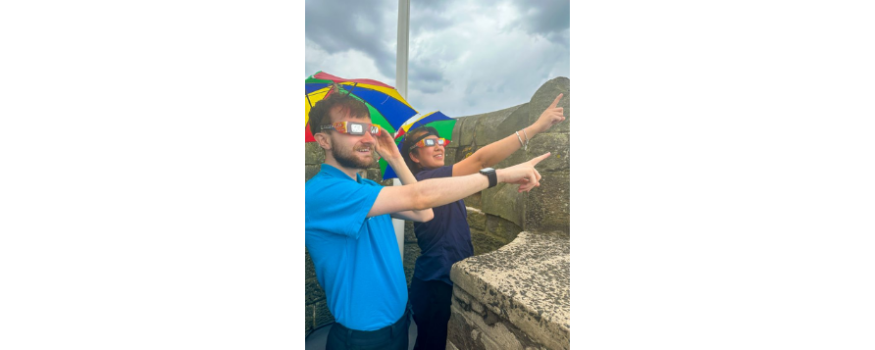
Camera Obscura & World of Illusions invited visitors to experience one of the most astronomical events of a generation from its rooftop terrace on Wednesday 12 August 2026. The partial solar eclipse was the closest the British Isles came to a total eclipse in almost 27 years. In Edinburgh, the moon was expected to cover around 91% of the Sun, creating a dramatic crescent in the sky and a noticeable change in the evening light.
The eclipse began at approximately 6.08pm, reached its maximum at 7.05pm and finished at around 8.00pm. Perched high above the Royal Mile, beside Edinburgh Castle, Camera Obscura’s rooftop terrace offers panoramic views across the city and a clear outlook towards the western sky, where the eclipse unfolded close to sunset. Visitors were also able to view the eclipse safely through the Camera Obscura itself, with guides detailing the event during demonstrations.
Andrew Johnson, General Manager at Camera Obscura & World of Illusions, said, “There can’t be many more memorable places to experience an eclipse than high above Edinburgh, with the city skyline around you. Our attraction takes its name from an invention that has been used to observe and understand light for centuries, so this extraordinary event feels like a perfect fit for us. We’re excited to help visitors enjoy the spectacle safely and learn a little more about the science behind it along the way. The eclipse took place close to sunset, making our Rooftop Terrace a wonderful vantage point. We kept everything crossed for clear Edinburgh skies!”
The Latin term camera obscura means “dark room”. Early versions of the device used a small opening to project an image of the outside world onto a surface inside a darkened space, a principle that has also been used throughout history to study solar eclipses without looking directly at the Sun.
The 12 August eclipse was visible as a partial eclipse throughout the UK and Ireland, while parts of Greenland, Iceland and northern Spain experienced a total solar eclipse.
Find out more here.