


UKinbound member, TravelAd, discusses how unpredictable summer weather is forcing travellers and the tourism industry to rethink fixed itineraries, opening hours and real-time communication in this guest blog.
On a recent trip to Amsterdam, I watched the canal boats bake in hostile afternoon heat, their passengers shrinking into whatever shade the deck offered. On the bridges above, a few braver tourists pressed on regardless, hiding under umbrellas as the sun bore straight down on streets never built with this kind of heat in mind. Nobody on those boats had planned for this. They had planned a canal tour, in a city famous for mild grey skies, and found themselves instead re-enacting a plan built for a version of Amsterdam that no longer quite exists in June.
It is a small moment, but it captures something this series has returned to all year in different guises: geopolitical uncertainty, an algorithm-driven discovery, and now, quite literally, the weather: the moment a plan is made and the moment it is lived in keep drifting further apart.
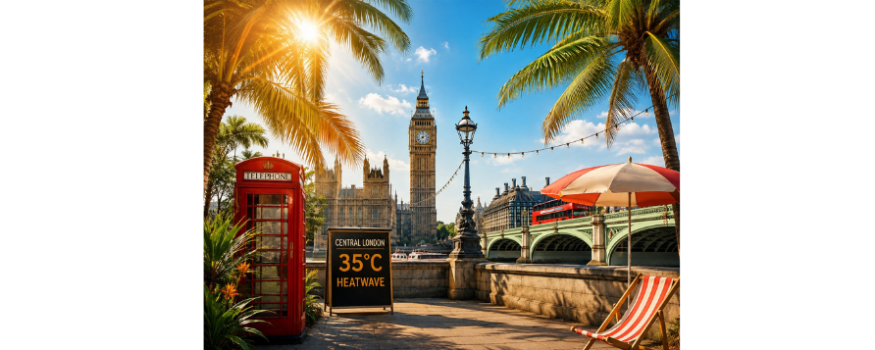
European summers have grown steadily hotter and less predictable in recent years, with temperature swings that used to be rare now arriving as a matter of course, and this year, Europe’s third heatwave of the summer, has pushed that pattern further than most. In Paris, the Louvre and the Eiffel Tower have both cut their hours, the Tower shutting its gates as early as 4pm, eight hours ahead of the schedule printed in every guidebook and travel app. The Arc de Triomphe has shortened its hours too, the Atomium in Brussels has been closing before the hottest part of the day arrives, and outdoor attractions at Disneyland Paris have been shuttered mid-season. In London, tourists gathering outside Buckingham Palace for the Changing of the Guard have found the ceremony cancelled, two days running, to protect the soldiers and horses from the heat.
None of this is a one-off, and it is doing something more interesting than making people uncomfortable. It is breaking the basic assumption that a tourism itinerary is planned once and then simply followed.
Opening Hours Used to Be a Fact. Now They’re a Forecast.
That stability, doors opening and closing at the times printed on the website, is what made pre-planned itineraries possible in the first place. Strikes and delays are disruptions to getting somewhere. This is a disruption to what happens once you’ve already arrived, standing in the heat, at the place you came specifically to see.
Travellers Are Already Adjusting. The Industry Is Slower.
The behaviour shift is measurable. The European Travel Commission’s sentiment survey for summer 2026 found that safety is now the leading factor travellers weigh when choosing a destination, ahead even of weather stability, a sign that heat itself has become something travellers actively plan around rather than simply endure.
It also shows up in when people decide, not just how they weigh a destination. Lighthouse’s analysis of three years of global hotel search data found the global share of accommodation searches made within 28 days of arrival rose nine percentage points between Q1 2023 and Q4 2025, with Europe among the largest regional shifts. Separately, Criteo’s Winter 2025 Travel Pulse found the share of US travellers finalising bookings within two weeks of departure rose from 29% to 34% year on year, with the equivalent European figure climbing to 26%.
Within destinations, the pattern is just as visible. Daytime sightseeing has thinned out across major cities, while evening activity, later dinners, night openings, and cooler-hour excursions have picked up the slack. I heard a good illustration of this recently from a colleague who runs a large boat operation: night sailing, once a niche add-on, has become their best-selling product this summer. Travellers are already rewriting their days around the heat. Many attractions and destinations are still operating, and communicating, as though the day is shaped the way it always has been.
The Real Gap Isn’t the Closure. It’s the Lag Between the Closure and the Traveller Knowing.
An attraction deciding to shut early because of extreme heat is a reasonable, defensible decision. Nobody is arguing that the Louvre should keep its doors open at 44 degrees for the sake of a booking made in spring.
The harder problem is that the decision to close is usually made faster than the information reaches the person already walking toward the entrance. A sign on the door, a note buried on a website, a single social post that a visitor from Jakarta or São Paulo, mid-trip and without the local news on their radar, has no reason to have seen. The closure itself is a sensible operational response. The gap between the closure and the traveller finding out about it is where the actual damage happens: a wasted afternoon, a missed highlight of the trip, a visitor who leaves the country having queued for something that was never going to open.
That gap is not really a weather problem. It is an information problem that weather has suddenly made urgent.
What This Means Going into Next Summer
If this is the third heatwave of one season rather than a one-off event, it’s worth treating it as a pattern rather than an exception. A few things follow from that.
Itineraries, whether built by a traveller, a tour operator, or a destination marketing team, need to be treated as provisional rather than fixed once the trip begins. The printed hours are a starting assumption, not a guarantee.
Attractions and destinations that depend on visitor flow will need faster ways of getting operational changes in front of the specific people affected, not just onto a website that assumes someone is checking it. A closure notice that reaches a traveller after they’ve already queued for forty minutes in 40-degree heat hasn’t really done its job. This is already technically solvable: platforms such as TravelAd can message inbound travellers directly, at the moment a change happens, rather than relying on them to have seen a sign or a website update, though the industry’s use of that kind of real-time channel is still catching up to the need for it.
There’s an irony worth sitting with here too. Europe has long been a natural summer escape for travellers from the GCC, leaving temperatures well above 40 degrees at home for what used to be a reliably milder few months in London, Paris, or Amsterdam. That gap is closing. With nine European countries recording peaks as high as 48.8 degrees this summer, the contrast that made Europe an escape in the first place is eroding, and that matters directly for the source markets this series has already flagged as central to inbound growth. If safety has genuinely overtaken weather stability as the top decision criterion for European summer travel, destinations built around extreme heat need to think about how they market and manage the days it actually arrives, not just the season around it.
The heatwave will pass, as it always does. The question worth sitting with is whether an industry built around the idea of a fixed itinerary can keep up with a summer that no longer behaves like one.
For more information on TravelAd, click here.